
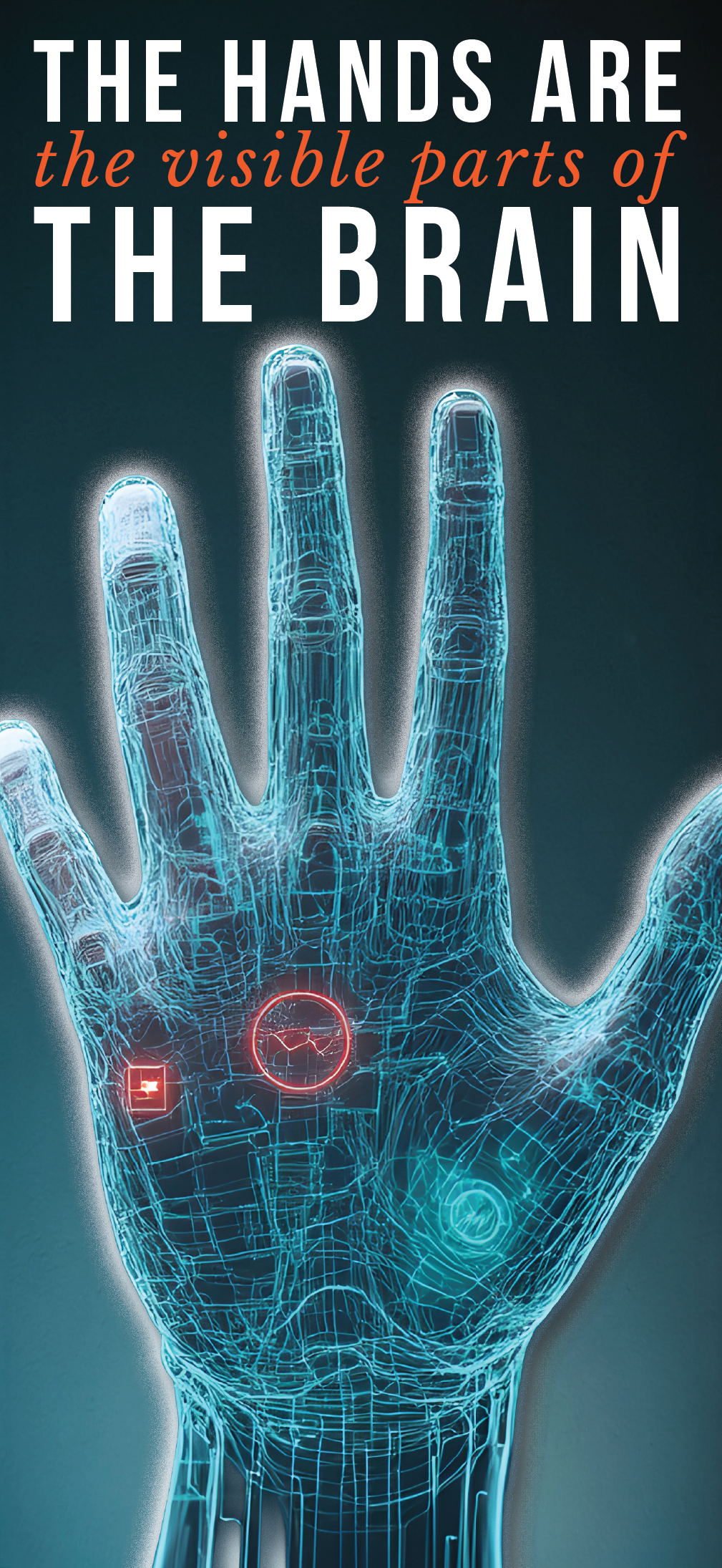
The Hands Are The Visible Part of the Brain
The Hands Are The Visible Part of the Brain
Why Whole-Body Adjustments Matter
An online companion to your Jeter Chiropractic Clinic patient handout
When people think about chiropractic care, they often picture “back pain” or “neck pain.” But your spine is more than a stack of bones—it’s a central support system for movement, balance, and coordination across the entire body. In many ways, the hands (and how well they move, grip, and coordinate) can reveal what’s happening “upstream” in the nervous system and “downstream” in posture, joint mechanics, and daily wear-and-tear.
At Jeter Chiropractic Clinic, our focus is whole-body, traditional chiropractic care to help you move better, reduce strain, and stay active. The goal isn’t to make your body “perfectly straight.” It’s to help your body function with less compensation—so joints, muscles, and connective tissues share the workload the way they were designed to.
Anatomy basics: how everything connects
The spine: your body’s framework
Your spine is made up of the cervical (neck), thoracic (mid-back), lumbar (low back), and sacral/pelvic regions. Between the bones are discs that help absorb shock. Surrounding the spine is a support network of ligaments, muscles, and fascia that stabilizes and moves you throughout the day.
The nervous system: communication for movement and sensation
Your brain, spinal cord, and nerves constantly coordinate movement quality—everything from balance and posture to fine motor control in the hands. When joints move well and tissues aren’t chronically irritated, the body moves more efficiently and comfortably.
The shoulders, hips, and extremities: where compensation shows up
When one area doesn’t move well, another often has to “pick up the slack.” For example, restricted hip motion can change your gait and place added stress on the low back or knees. Likewise, poor upper-back or neck mechanics can influence shoulder motion and sometimes contribute to arm or hand strain during repetitive activities.
The Hands
Your hands make up 25% of the bones in your entire skeleton! They are built for both strength and precision. Each hand contains 27 bones (carpals, metacarpals, and phalanges) arranged into multiple small joints, supported by a network of ligaments, tendons, and muscles. Some muscles that move the fingers live in the hand itself, while many of the tendons that power gripping and fine finger motion originate in the forearm and travel through tight “tunnel” spaces at the wrist. Because the hand depends on smooth coordination from the neck, shoulder, elbow, wrist, and fingers, problems anywhere along that chain can affect comfort and performance.
Common hand and wrist problems people experience
Hand symptoms often develop from overuse, repetitive gripping, prolonged typing, vibration tools, sports, and arthritis-related wear-and-tear. Common issues include:
- Carpal tunnel syndrome (median nerve irritation at the wrist), which may cause numbness/tingling in the thumb, index, and middle fingers—often worse at night.
- Tendon irritation and tenosynovitis (such as De Quervain’s–type thumb-side wrist pain), often linked to repetitive thumb use or lifting.
- Trigger finger (a finger that catches or locks when bending/straightening) related to tendon/pulley irritation.
- Arthritis and joint stiffness in the fingers or base of the thumb, which can reduce grip strength and dexterity.
- Sprains/strains from falls, sudden loading, or sports.
If you have sudden loss of strength, significant swelling/deformity after an injury, progressive numbness, or persistent symptoms that are not improving, you should be evaluated promptly to rule out fracture or significant nerve compression/entrapment neuropathies.
Chiropractic helps prevent and/or treat hand-related conditions
A chiropractic plan for hand and wrist complaints is usually “whole-chain,” meaning it addresses not only the hand, but also the joints and tissues that feed into it. Depending on your exam findings, care may include:
- Extremity chiropractic adjustments of the wrist, hand, elbow, and sometimes the shoulder, to support healthier joint motion and mechanics.
- Soft-tissue massage for the forearm flexors/extensors and hand muscles to reduce overuse tension and improve tissue flexibility.
- Nerve and tendon “gliding” exercises, plus targeted mobility and strengthening, to improve tolerance to repetitive tasks.
- Ergonomic coaching for keyboard/mouse setup, gripping mechanics, tool use, and activity pacing—often a major factor in preventing recurrence.
Your chiropractor will also let you know when hand symptoms fall outside a typical musculoskeletal pattern and should be co-managed or referred (for example, suspected fracture, significant nerve compression, inflammatory arthritis, or systemic causes).
Why whole-body alignment matters for longevity and dexterity
Alignment matters because it affects how forces travel through your body. When posture and joint motion are imbalanced, certain tissues may be loaded more than they can tolerate—especially during repetitive work, exercise, or long periods of sitting.
By improving motion and mechanics, chiropractic care may help you:
- Move with less restriction and stiffness
- Reduce repetitive strain and overuse patterns
- Recover more efficiently from daily stress and activity
- Support long-term joint and tissue health
Chiropractic options that support whole-body alignment
A traditional chiropractic approach typically combines hands-on care with movement guidance. Your plan is based on your history, exam findings, comfort level, and goals.
Chiropractic adjustments may be used to help restore motion in the spine and, when appropriate, in extremity joints such as the shoulder, wrist, hip, knee, ankle, or foot. Many patients also benefit from mobilization and soft-tissue therapy, which can address muscle tension, trigger points, and restrictions that make movement feel “stuck.”
For lasting results, care often includes corrective exercise and mobility work to improve stability, coordination, and endurance. Finally, ergonomics and lifestyle strategies—like desk setup, lifting mechanics, and sleep positioning—can help reduce flare-ups and protect your progress between visits.
Simple alignment habits you can start today
The most effective changes are often the most consistent ones. Move more frequently throughout the day, build basic mobility and strength (especially in the hips, upper back, core, and glutes), and pay attention to positions that repeatedly aggravate symptoms. Addressing small warning signs early—stiffness, recurring tightness, mild aches—often prevents larger problems later.
If you’re dealing with pain, stiffness, recurring injuries, or you simply want to move better and stay active longer, a whole-body chiropractic approach may help.